- status: draft
- in this article i describe the new type of policy for a more adoptable societies
- i am going to bet on it while building citadel genesis
- simple idea to solve sociodemgraphic collapse at low scale
- using gender price differentiation as result of community consensus
- powerful males agree to pay significantly more when females and in exchange enjoy prosperity
- smart females agree to share male and kids and in exchange also enjoy prosperity
- everyone agree on economical domination of females over males in all key areas
-
disclaimer
- being in blockchain community since the beginning i observed how males dominated the space
- still up to 90% of participants in almost all engineering ralated events are males
- this led to an extremely uneven capital distribution between genders
- i think that was one of the biggest mistakes while building the industry
- during citadel construction i believe even achieving normal balance 50/50 is already awesome
- but if the society we build choose to growth really fast we have to look deeper into the culture more rationally
- the effect suggested by research that female-biased societies, if well-managed
- could potentially lead to more rapid growth
- better social outcomes
- and increased resilience
- offering a competitive edge in various domains
- however, achieving and maintaining these benefits would require thoughtful programming
- key assumption is that population growth rate
- is not only result of economic output
- but also rely heavily on ratio between males and females
- there have been observations and studies
- that suggest the gender balance in a population
- can influence population growth
- though the effects are complex and context-dependent
- key observations
- female-biased sex ratios
- in populations where there are more females than males, such as a 3:1 female-to-male ratio
- population growth accelerate significantly
- this is because each male can potentially father offspring with multiple females
- leading to a higher birth rate and resource efficiency
- male-biased sex ratios
- when there are more males than females in a population
- it can lead to increased competition among males for mates
- resulting in heightened aggression and selective pressures
- this often reduces birth rates since fewer females are available to reproduce
- which can slow population growth and decrease genetic diversity
- additionally, social structures may become disrupted
- leading to behavioral changes and potential instability
- over time, a persistent male-biased ratio can cause long-term demographic imbalances
- including population decline and shifts in population structure due to migration or dispersal
- the specific effects vary depending on species, mating systems, and environmental factors
- 1:1 sex ratios
- explained by fishers principle
- on populations with a roughly equal number of males and females
- population growth is more stable but may not be as rapid as in a female-biased ratio
- the reproductive capacity is more evenly distributed among the males
- leading to a balance between mating opportunities and offspring production
- benefits of 3:1 female:male target ratio
- significantly accelerated population growth
- simple model with demonstration starting from 1000 population
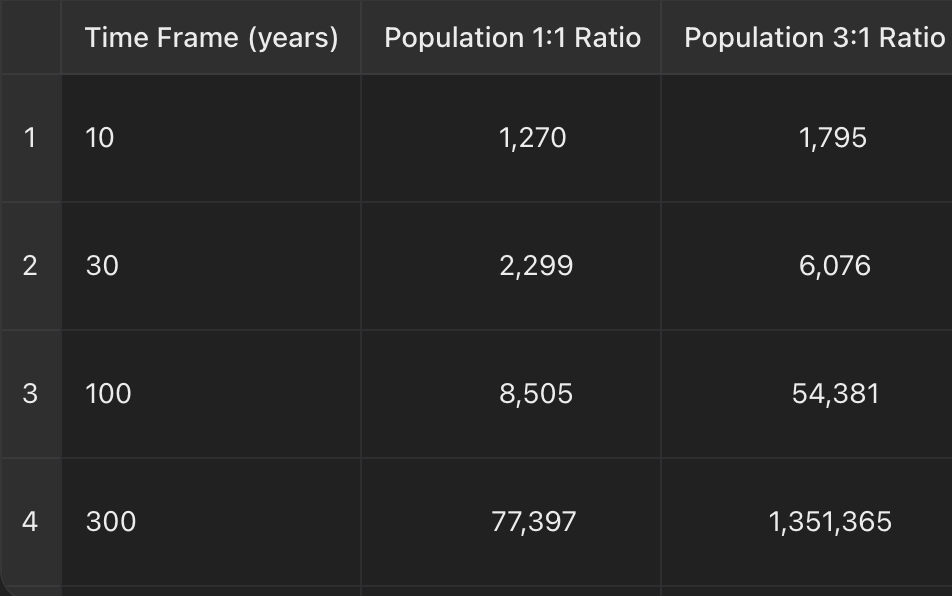
- enhanced collective intelligence of community
- research by wolley suggests
- that groups with higher female representation
- tend to perform better in collaborative problem-solving and decision-making
- leading to more innovative and effective solutions to complex challenges
- economic growth and innovation
- as a result of a more dense resource usage needed to produce one offspring
- larger, more diverse labor pool of female-biased society
- environmental sustainability
- women are often more involved in sustainable practices and environmental conservation
- which can lead to better management of natural resources
- and a stronger focus on ecological sustainability
- social cohesion and stability
- women often play key roles in community-building and social networking
- which can enhance social cohesion and stability
- stronger social support systems and more resilient communities
- focus on family and education
- societies with more women may place a greater emphasis on
- family welfare, education, and child development
- leading to better outcomes in these areas
- balanced resource management
- studies suggest that women often manage resources in ways
- that prioritize long-term sustainability
- which can contribute to more stable economic growth
- better health and well-being
- female-biased societies may prioritize healthcare
- particularly maternal and child health
- leading to overall improvements in public health and life expectancy
- lower crime rates
- some studies indicate that societies with more women
- tend to have lower crime rates, particularly violent crimes
- contributing to a safer and more stable environment
- promotion of peace
- may be more inclined towards peaceful conflict resolution and diplomacy
- potentially reducing the likelihood of war and social unrest
- focus on humanism
- with more women in leadership roles
- there might be a stronger focus on human rights, social justice, and equality
- leading to a more inclusive and ethical society
- balanced and diverse leadership
- female-biased societies may have more women in leadership positions
- leading to more balanced governance
- that reflects diverse perspectives and priorities
- effective governance and policy implementation
- women in leadership roles have been shown to be effective in implementing policies
- that address social issues, such as healthcare, education, and family welfare
- greater resilience to social and economic shocks
- female-biased societies is likely to develop
- more adaptive social structures
- that are better able to cope with economic or environmental crises
- ensuring long-term resilience and stability
- cultural soft power
- if female-biased societies become known for their stability, innovation, and prosperity
- they may exert greater cultural and diplomatic influence on the global stage
- they might project an image of superiority
- setting trends, attracting talent, investment, and alliances
- raising issues and their mitigations
- resources availability
- expensive physical force
- as males are rare and mostly resourceful there is an issue with physical force availability
- however with focus on robotics, animal education and nurturing soft force
- the issue become advantage
- social imbalance and gender inequality
- genetic diversity and population health
- a hacked gender ratio might reduce genetic diversity
- particularly if fewer males are contributing to the gene pool
- this could lead to increased vulnerability to diseases and other genetic issues
- however if genetic set of males is engineered
- the issue could also become advantage
- as population can have scientifically and analytically
- diverse enough set of genes which are also powerful
- over dependence on social welfare systems
- a larger female population might lead to overdependence on social welfare systems
- especially if many women are single or supporting children without partners
- we are going to handle this using
- ethical and moral considerations
- acceptance of polygamous form or relations as social norm
- the intentional manipulation of gender ratios and related social policies
- might raise ethical concerns, leading to resistance or backlash from certain segments of society
- long-term sustainability
- maintaining such a ratio over generations could prove challenging
- especially if external factors (e.g., migration, cultural shifts, economic crises) disrupt the balance
- so the ratio must be carefully maintained and decreased on saturation
- social engineering risks
- the level of social engineering required to maintain a stable 3:1 ratio
- seems to involve significant interventions in personal and societal choices,
- which could lead to resistance, ethical concerns, or unintended consequences
- however our policy is voluntary, pure economical
- and never intended to have any other policies for maintaining gender ratio
- so it seems this is at least concern
- global backlash
- other societies might view the deliberate manipulation of gender ratios with suspicion or hostility
- leading to diplomatic or economic conflicts
- conclusion
- a society that can remain stable at a 3:1 female-to-male ratio
- through careful cultural and economic programming
- might have advantages
- that could lead to a form of dominance over societies that do not follow this approach
- however, this dominance would likely be contingent on the society’s ability
- to manage the inherent challenges, maintain long-term sustainability, and navigate the global response
- to its unique social structure
- the success of such a society would depend on its
- adaptability
- resilience, and the
- effectiveness
- of its policies in harnessing the full potential of its population